DR CONGO · DR Congo · Digital poster
Kuba cloth (raffia pattern)
A pattern that falls out of step on purpose.
Colour: Night blue, light ground
€6.90
Digital file · instant download · no shipping
Download link valid for 30 days · up to 10 downloads · details
The download link is valid for 30 days from the date of provision and may be used a maximum of 10 times.
What you get
- · The chosen colour as 4 vector PDFs for standard frames: 50 × 70 cm (also 40 × 56, 30 × 42), ISO A (A4–A1), 3:4 (30 × 40, 45 × 60 cm, 18 × 24 in), 2:3 (20 × 30, 40 × 60, 60 × 90 cm, 24 × 36 in) — plus the same as JPG for copy shops and photo services (300 dpi up to A2 or 20 × 30 in; larger: use the PDF)
- · PDF: sharp at any size · JPG: 300 dpi at the stated size, plus a short printing guide
- · Files, not a printed poster, no frame
- · For private use, not for resale
Licence
With your purchase you acquire a non-exclusive, non-transferable licence for private use of the files. Permitted: printing for your own private use (also via a copy shop or photo service).
Prohibited: reselling or passing on the files, commercial use, making products for sale, using the files to train AI systems, or any public distribution of the files.
All copyright and other rights in the designs remain with the seller.
Where to print?
- · Copy shop near you: bring the PDF on a USB stick or send it by e-mail
- · Photo service in a drugstore or online: choose a poster size of the same shape (e.g. A3 or 30 × 40)
- · At home: up to A3 on a good printer
- · Tip: matte paper around 200 g/m² looks best
About the design
Kuba cloth is the raffia textile of the Kuba people of the Kasai region in the Democratic Republic of the Congo. Its geometric patterns are among the most admired designs of Africa.
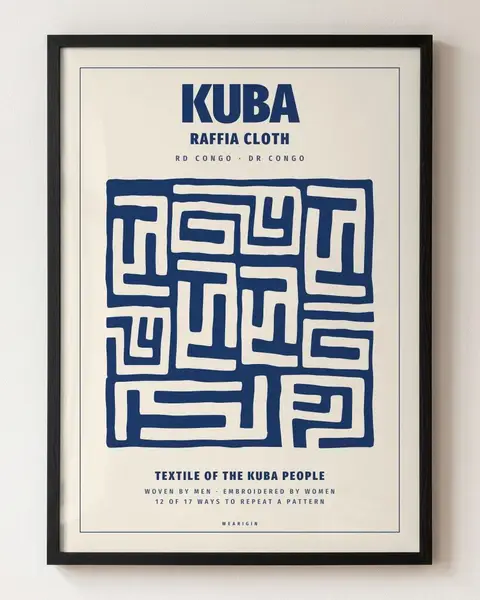
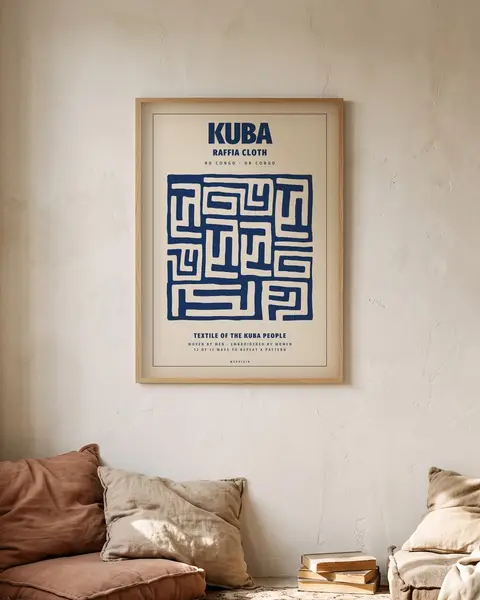
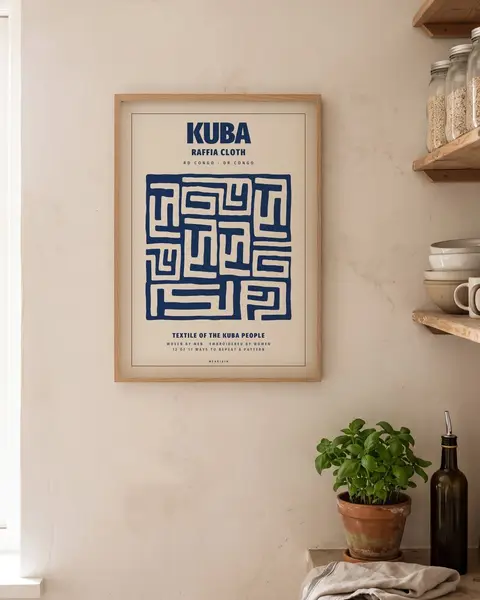
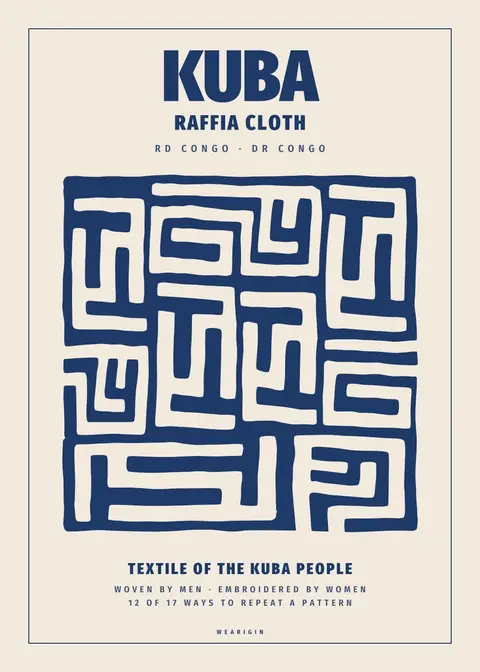
The work is shared. Men grow the raffia palms and weave the base cloth on inclined single-heddle looms; a square of about 65 by 70 centimetres takes two to three hours. The cloth is pounded in a mortar to soften it and dyed; the deep red called twool, from the heartwood of the camwood tree, is kept for prestige cloths and is believed to protect. Women then embroider: with stem stitch, with cut pile that gives a velvet surface, and with appliqué. A woman’s ceremonial overskirt, about 7.5 metres long, is assembled from blocks worked by several women, and a single block can take months or years. The mathematician Donald Crowe found that the Kuba used 12 of the 17 possible ways of repeating a pattern on a surface, and that they liked to break a pattern on purpose. Our drawing is a free interpretation, not a copy of one cloth. An almost square field of broad angular paths turns inward at right angles, and here and there a path stops short before a crossbar, as a Kuba pattern does. The name “kuba” and DR CONGO stand beneath.
For a Congolese home abroad, for lovers of pattern, or for a wall that wants a rhythm that breaks its own rule.
A pattern that falls out of step on purpose.