EESTI · Estonia · Digital poster
Sõlg (brooch)
A silver brooch meant to protect and adorn.
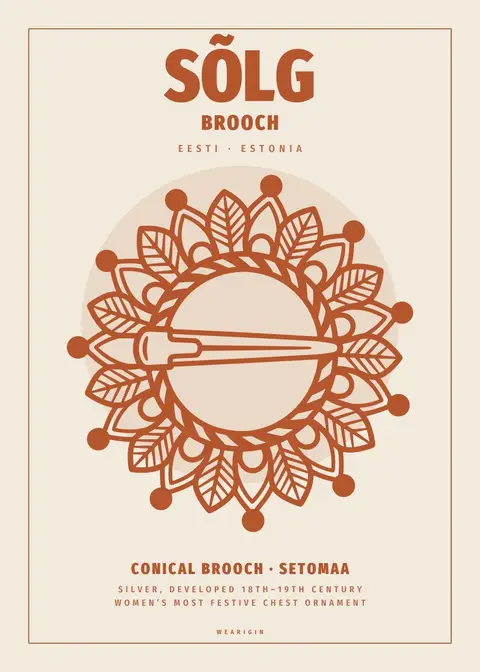
Colour: Terracotta, light ground
€6.90
Digital file · instant download · no shipping
Download link valid for 30 days · up to 10 downloads · details
The download link is valid for 30 days from the date of provision and may be used a maximum of 10 times.
What you get
- · The chosen colour as 4 vector PDFs for standard frames: 50 × 70 cm (also 40 × 56, 30 × 42), ISO A (A4–A1), 3:4 (30 × 40, 45 × 60 cm, 18 × 24 in), 2:3 (20 × 30, 40 × 60, 60 × 90 cm, 24 × 36 in) — plus the same as JPG for copy shops and photo services (300 dpi up to A2 or 20 × 30 in; larger: use the PDF)
- · PDF: sharp at any size · JPG: 300 dpi at the stated size, plus a short printing guide
- · Files, not a printed poster, no frame
- · For private use, not for resale
Licence
With your purchase you acquire a non-exclusive, non-transferable licence for private use of the files. Permitted: printing for your own private use (also via a copy shop or photo service).
Prohibited: reselling or passing on the files, commercial use, making products for sale, using the files to train AI systems, or any public distribution of the files.
All copyright and other rights in the designs remain with the seller.
Where to print?
- · Copy shop near you: bring the PDF on a USB stick or send it by e-mail
- · Photo service in a drugstore or online: choose a poster size of the same shape (e.g. A3 or 30 × 40)
- · At home: up to A3 on a good printer
- · Tip: matte paper around 200 g/m² looks best
About the design
Sõlg is the Estonian word for brooch, the pin that closes the shirt at the neck. In the folk costume it became far more than a fastener: the most festive ornament a woman owned.
Brooches have been worn in Estonia since the Iron Age, and the small ring-shaped vitssõlg was worn across the whole country from the 13th century until folk costume went out of use in the 19th and 20th centuries. Farmers fastened their shirts with horseshoe-shaped brooches until the 17th century. From a large ring brooch of the 16th and 17th centuries grew the kuhiksõlg, the conical brooch of the 18th and 19th centuries: a gently domed disc, usually of silver, worn on the chest. It became the most festive chest ornament of Estonian women. The largest, up to about 35 centimetres across, were worn in Setomaa in the south-east, where a bride carried kilograms of silver at her wedding. Heart-shaped brooches survived longest on the island of Saaremaa.
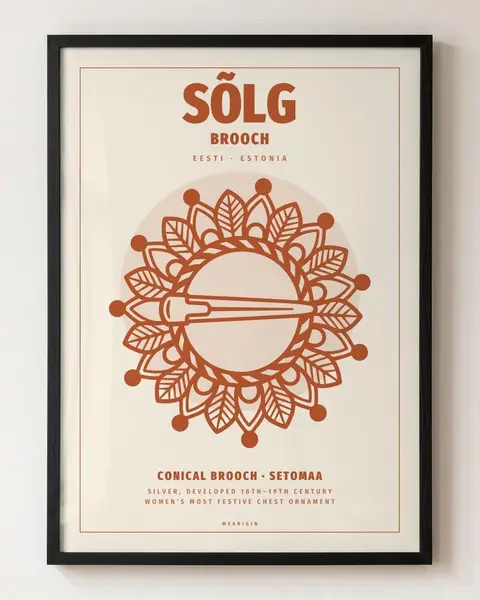
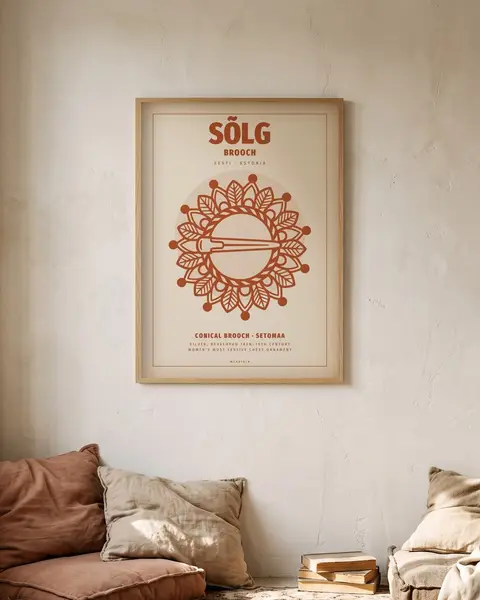
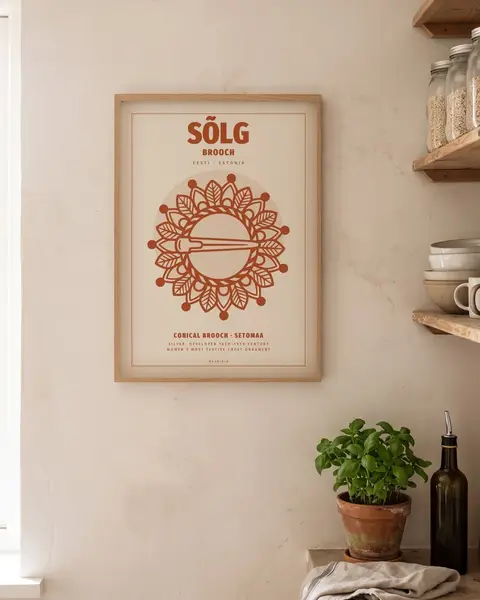
Our drawing is a free interpretation, not a copy of one historical brooch. A round disc with a pin lying across it sits inside a ring of pointed leaves with small circles between their tips, each leaf divided by fine lines. The name “sõlg” and ESTONIA stand beneath.
For an Estonian home abroad, for anyone who wore the costume at a song festival, or for a wall that wants a sun of silver.
A fastener that became a sign of standing and festivity.