تونس · Tunisia · Digital poster
Bab (Tunisian door)
The door divides two worlds: the street and the home.
Colour: Terracotta, light ground
€6.90
Digital file · instant download · no shipping
Download link valid for 30 days · up to 10 downloads · details
The download link is valid for 30 days from the date of provision and may be used a maximum of 10 times.
What you get
- · The chosen colour as 4 vector PDFs for standard frames: 50 × 70 cm (also 40 × 56, 30 × 42), ISO A (A4–A1), 3:4 (30 × 40, 45 × 60 cm, 18 × 24 in), 2:3 (20 × 30, 40 × 60, 60 × 90 cm, 24 × 36 in) — plus the same as JPG for copy shops and photo services (300 dpi up to A2 or 20 × 30 in; larger: use the PDF)
- · PDF: sharp at any size · JPG: 300 dpi at the stated size, plus a short printing guide
- · Files, not a printed poster, no frame
- · For private use, not for resale
Licence
With your purchase you acquire a non-exclusive, non-transferable licence for private use of the files. Permitted: printing for your own private use (also via a copy shop or photo service).
Prohibited: reselling or passing on the files, commercial use, making products for sale, using the files to train AI systems, or any public distribution of the files.
All copyright and other rights in the designs remain with the seller.
Where to print?
- · Copy shop near you: bring the PDF on a USB stick or send it by e-mail
- · Photo service in a drugstore or online: choose a poster size of the same shape (e.g. A3 or 30 × 40)
- · At home: up to A3 on a good printer
- · Tip: matte paper around 200 g/m² looks best
About the design
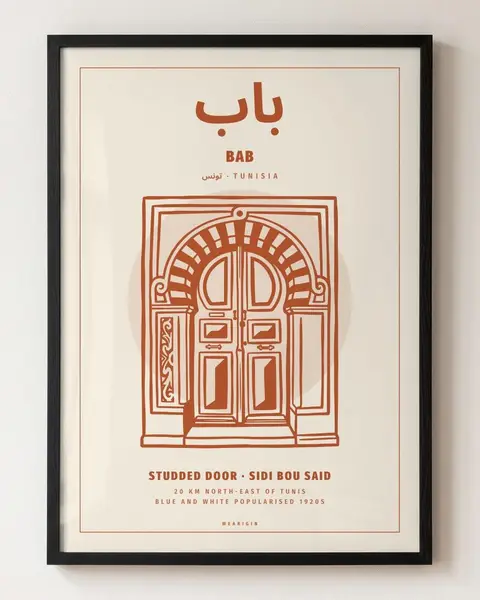
Bab is the Arabic word for door. In the medina of Tunis and in the villages on the coast the door of a house is its face to the street: an arch of stone, two wooden leaves studded with nails in patterns, and behind them a courtyard that nobody outside sees.
Sidi Bou Said, on a cliff 20 kilometres north-east of Tunis, is the best-known place to see them. The village grew around the shrine of the Sufi saint Abu Said al-Baji, who settled there in the 12th or 13th century and was buried there in 1231. In the 1920s Rodolphe d’Erlanger made blue and white the colours of the village, and the blue doors with their studs became the picture of Tunisia. The nails are set in geometric and floral figures, a craft the Andalusians are said to have brought; visitors are told that the patterns spoke of the family and that the blue kept evil away. In 2026 the village was inscribed as World Heritage.
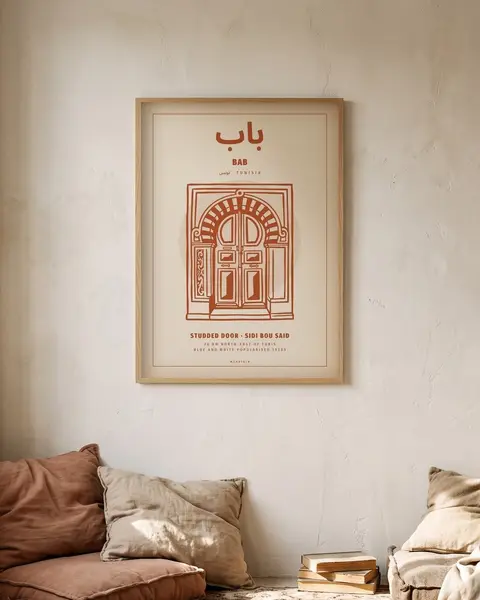
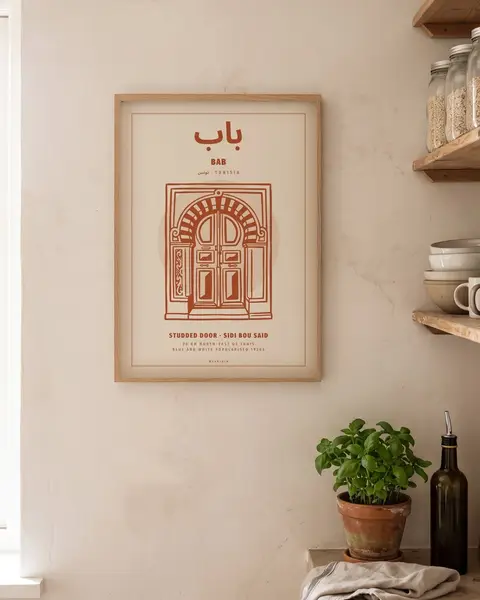
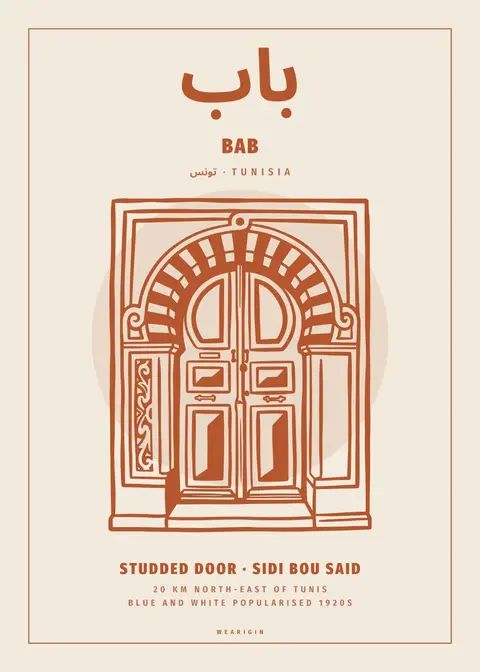
Our drawing is a free interpretation, not one particular door. A pointed arch of voussoirs frames two narrow leaves with panels and a small window in each, knockers in the middle and a carved band at the side, all drawn in outline. The name “bab” and TUNISIA stand beneath.
For a Tunisian home abroad, for anyone who has walked up the lane in Sidi Bou Said, or for a wall that wants a door that stays open.
The door divides two worlds: the street and the home.