SVERIGE · Sweden · Digital poster
Dala horse (dalahäst)
A horse from leftover wood that became the symbol of a country.
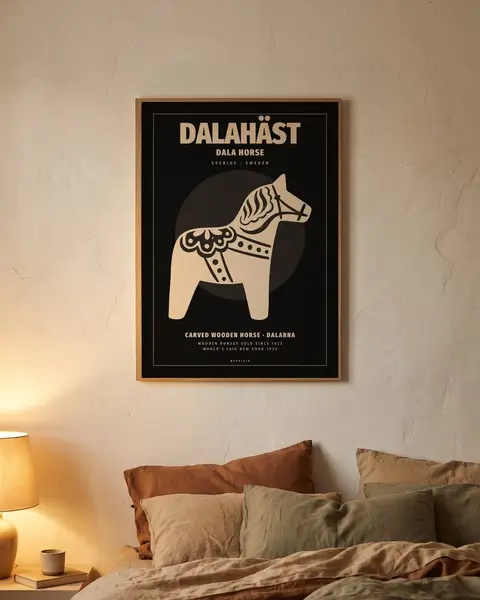
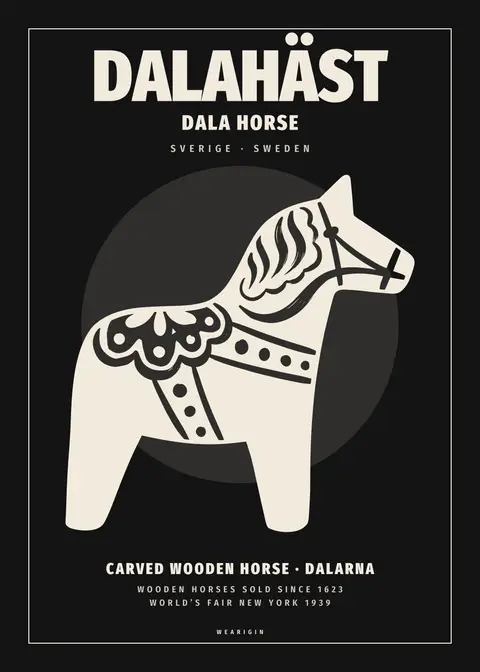
Colour: Black, dark ground
€6.90
Digital file · instant download · no shipping
Download link valid for 30 days · up to 10 downloads · details
The download link is valid for 30 days from the date of provision and may be used a maximum of 10 times.
What you get
- · The chosen colour as 4 vector PDFs for standard frames: 50 × 70 cm (also 40 × 56, 30 × 42), ISO A (A4–A1), 3:4 (30 × 40, 45 × 60 cm, 18 × 24 in), 2:3 (20 × 30, 40 × 60, 60 × 90 cm, 24 × 36 in) — plus the same as JPG for copy shops and photo services (300 dpi up to A2 or 20 × 30 in; larger: use the PDF)
- · PDF: sharp at any size · JPG: 300 dpi at the stated size, plus a short printing guide
- · Files, not a printed poster, no frame
- · For private use, not for resale
Licence
With your purchase you acquire a non-exclusive, non-transferable licence for private use of the files. Permitted: printing for your own private use (also via a copy shop or photo service).
Prohibited: reselling or passing on the files, commercial use, making products for sale, using the files to train AI systems, or any public distribution of the files.
All copyright and other rights in the designs remain with the seller.
Where to print?
- · Copy shop near you: bring the PDF on a USB stick or send it by e-mail
- · Photo service in a drugstore or online: choose a poster size of the same shape (e.g. A3 or 30 × 40)
- · At home: up to A3 on a good printer
- · Tip: matte paper around 200 g/m² looks best
About the design
The Dala horse, dalahäst, is a carved and painted wooden horse from Dalarna in central Sweden. It began as a toy made from leftover wood and became the symbol of a whole country.
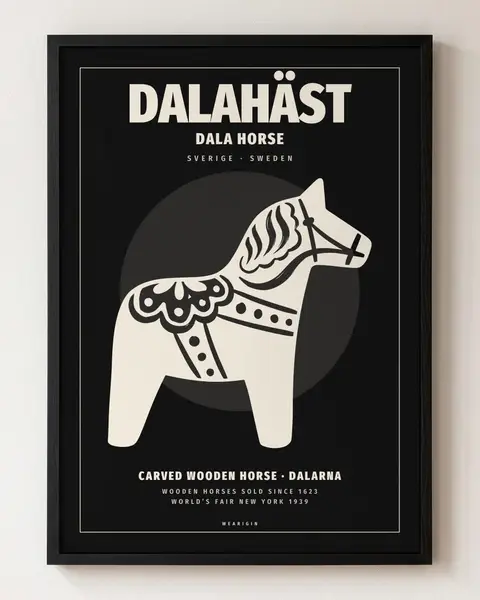
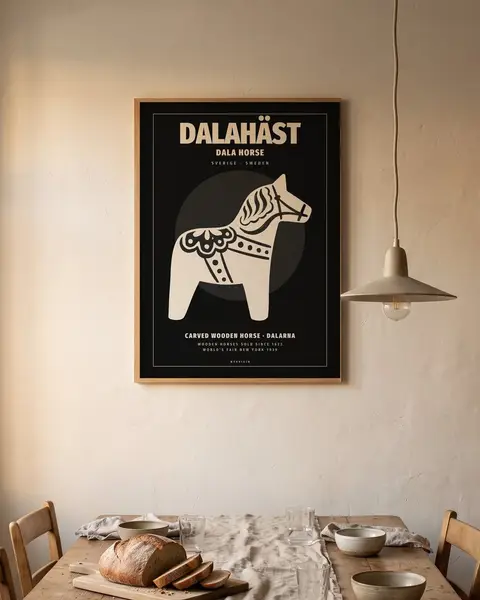
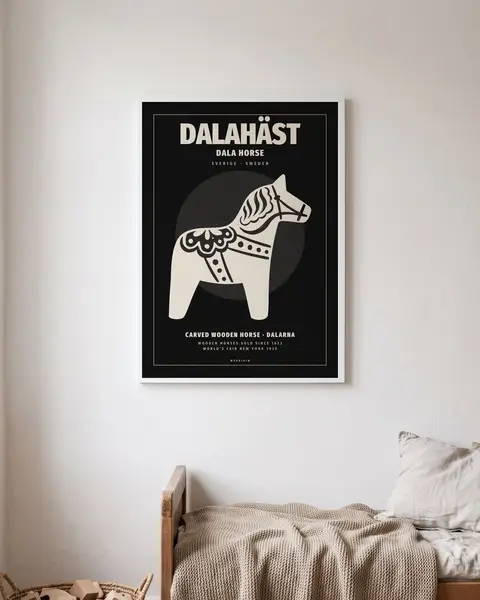
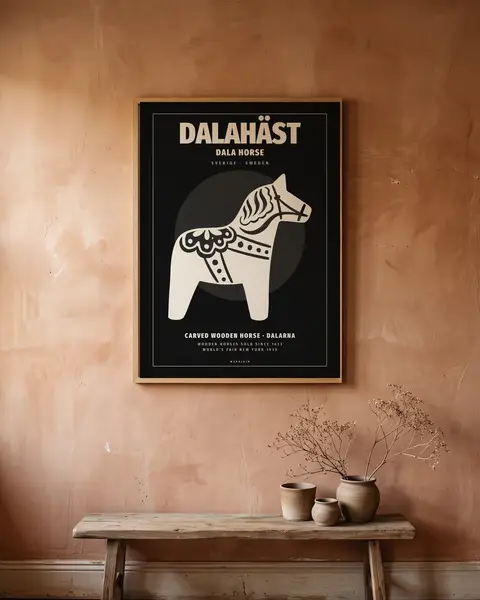
Carving started in the villages of Mora parish, in Bergkarlås first, then Risa, Vattnäs and Nusnäs; wooden horses for sale are recorded as early as 1623. The early horses were plain white or red; in the 19th century Stikå Erik Hansson of Risa introduced two-colour brush painting in the kurbits style, and the old red was iron-oxide red. Today the horse is usually reddish orange with a harness in white, green, yellow and blue. Mass production began in the 1930s, after the Paris exhibition of 1937 and the New York World’s Fair of 1939, where the architects of the Swedish pavilion chose the horse as its sign. The horses are still made in Nusnäs of pine from the forests around Lake Siljan; at least nine people work on each one, and Grannas A. Olssons Hemslöjd, founded in 1922, is the oldest maker still at work. Our drawing is a free interpretation, not a copy of one maker’s horse. A stocky horse in profile with a flat-carved body carries a painted saddle, harness bands with dots, a bridle and a wavy mane. The name “dalahäst” and SWEDEN stand beneath.
For a Swedish home abroad, for a child’s room, or for a wall that wants a horse from the forest.