PERÚ · Peru · Digital poster
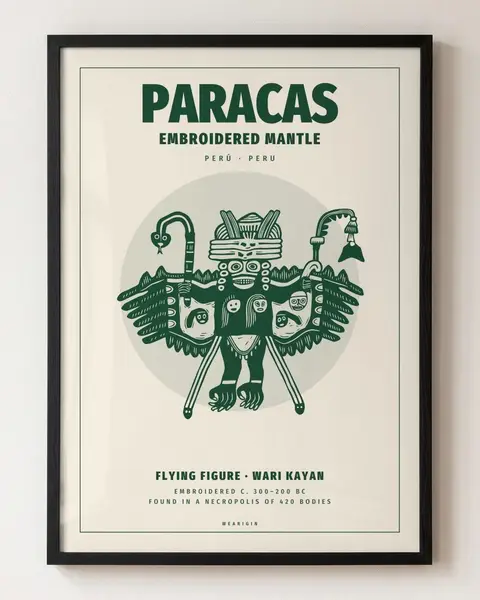
Paracas (supernatural bird)
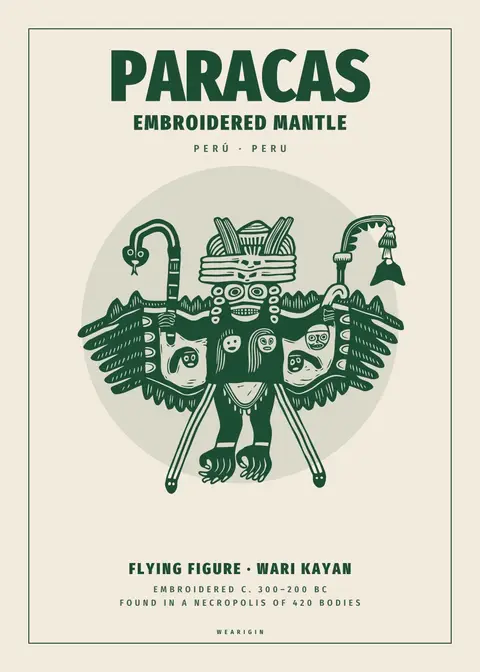
A bird being of wool, embroidered some 2,000 years ago.
Colour: Fir green, light ground
€6.90
Digital file · instant download · no shipping
Download link valid for 30 days · up to 10 downloads · details
The download link is valid for 30 days from the date of provision and may be used a maximum of 10 times.
What you get
- · The chosen colour as 4 vector PDFs for standard frames: 50 × 70 cm (also 40 × 56, 30 × 42), ISO A (A4–A1), 3:4 (30 × 40, 45 × 60 cm, 18 × 24 in), 2:3 (20 × 30, 40 × 60, 60 × 90 cm, 24 × 36 in) — plus the same as JPG for copy shops and photo services (300 dpi up to A2 or 20 × 30 in; larger: use the PDF)
- · PDF: sharp at any size · JPG: 300 dpi at the stated size, plus a short printing guide
- · Files, not a printed poster, no frame
- · For private use, not for resale
Licence
With your purchase you acquire a non-exclusive, non-transferable licence for private use of the files. Permitted: printing for your own private use (also via a copy shop or photo service).
Prohibited: reselling or passing on the files, commercial use, making products for sale, using the files to train AI systems, or any public distribution of the files.
All copyright and other rights in the designs remain with the seller.
Where to print?
- · Copy shop near you: bring the PDF on a USB stick or send it by e-mail
- · Photo service in a drugstore or online: choose a poster size of the same shape (e.g. A3 or 30 × 40)
- · At home: up to A3 on a good printer
- · Tip: matte paper around 200 g/m² looks best
About the design
On the dry Paracas peninsula of Peru’s south coast the dead of the Paracas culture were buried seated, bound with cord and wrapped in layer upon layer of embroidered cloth. Those cloths, two thousand years old, carry beings like the one on our poster: a winged figure with a masked face.
The Paracas culture lived in the Ica region from about 800 to 100 BC. Julio C. Tello first investigated the peninsula in the 1920s, and in October 1927 his team uncovered the first bundle burials of the necropolis of Wari Kayan: some 420 bodies, in groups of forty or fifty that may have been family vaults. The textiles were woven on backstrap looms of cotton and camelid wool, alpaca or llama, and embroidered in two styles; their natural dyes have kept their colour for more than 2,000 years, and some wrapping cloths were up to 34 metres long. The favourite motifs are the flying figure and the “Oculate Being”. The Nazca culture grew out of Paracas.
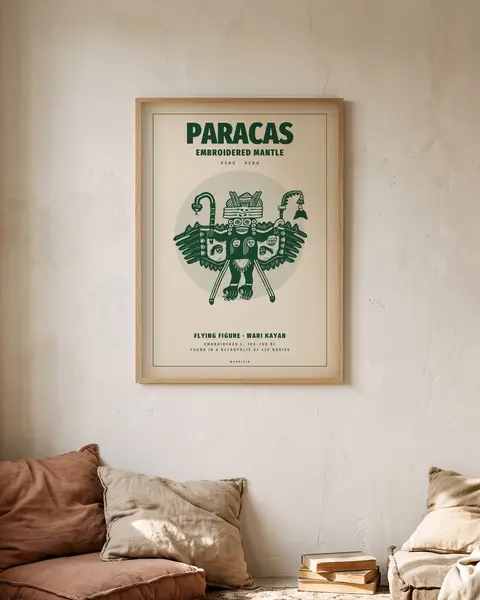
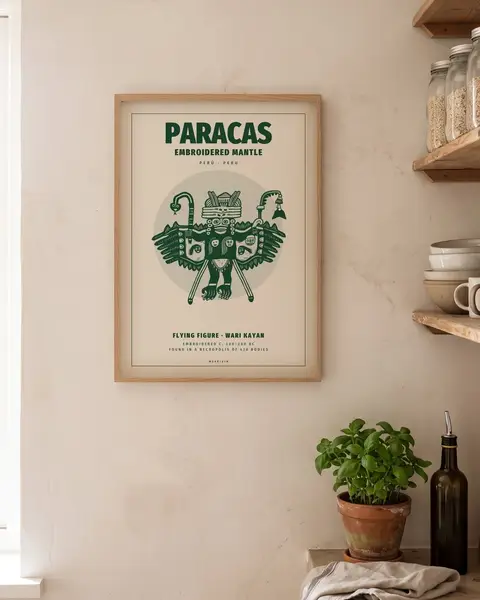
Our drawing is a free interpretation, not a copy of one mantle. A frontal figure with a masked face and headdress spreads broad feathered wings; the hands hold a curved staff and a serpent-like rod, small faces and heads cluster at the chest, and two thin legs end in feet. The name “paracas” and PERU stand beneath.
For a Peruvian home abroad, for lovers of ancient textiles, or for a wall that wants a being from before the Incas.
The flying figure of the Paracas embroideries; its name and its story are lost.