PILIPINAS · Philippines · Digital poster
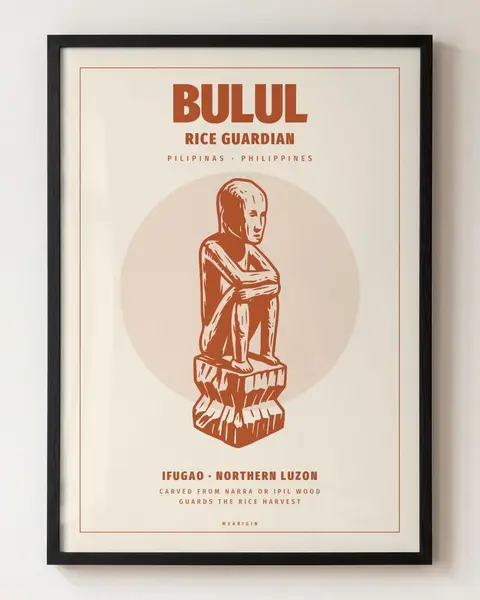
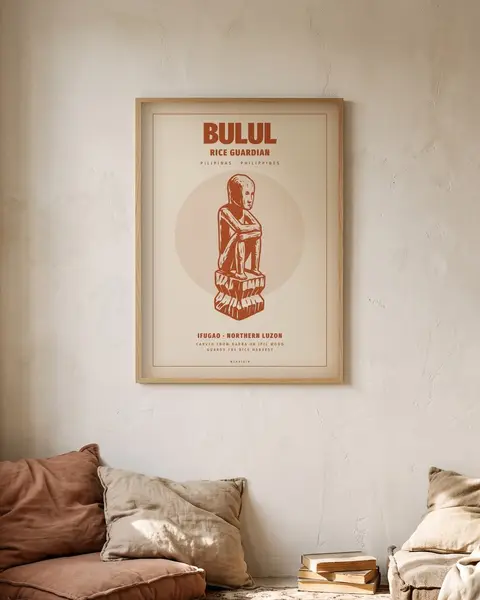
Bulul (Ifugao rice guardian)
A wooden guardian who watches over the rice harvest.
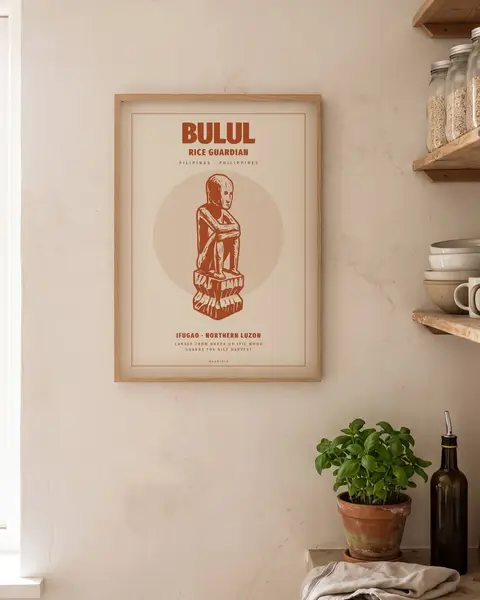
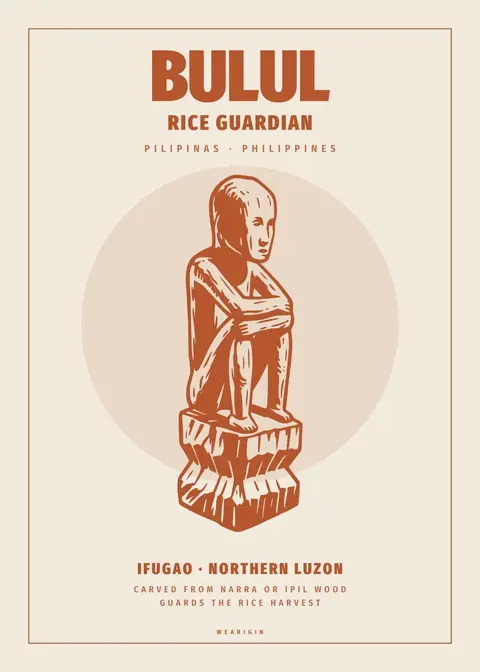
Colour: Terracotta, light ground
€6.90
Digital file · instant download · no shipping
Download link valid for 30 days · up to 10 downloads · details
The download link is valid for 30 days from the date of provision and may be used a maximum of 10 times.
What you get
- · The chosen colour as 4 vector PDFs for standard frames: 50 × 70 cm (also 40 × 56, 30 × 42), ISO A (A4–A1), 3:4 (30 × 40, 45 × 60 cm, 18 × 24 in), 2:3 (20 × 30, 40 × 60, 60 × 90 cm, 24 × 36 in) — plus the same as JPG for copy shops and photo services (300 dpi up to A2 or 20 × 30 in; larger: use the PDF)
- · PDF: sharp at any size · JPG: 300 dpi at the stated size, plus a short printing guide
- · Files, not a printed poster, no frame
- · For private use, not for resale
Licence
With your purchase you acquire a non-exclusive, non-transferable licence for private use of the files. Permitted: printing for your own private use (also via a copy shop or photo service).
Prohibited: reselling or passing on the files, commercial use, making products for sale, using the files to train AI systems, or any public distribution of the files.
All copyright and other rights in the designs remain with the seller.
Where to print?
- · Copy shop near you: bring the PDF on a USB stick or send it by e-mail
- · Photo service in a drugstore or online: choose a poster size of the same shape (e.g. A3 or 30 × 40)
- · At home: up to A3 on a good printer
- · Tip: matte paper around 200 g/m² looks best
About the design
A bulul is the carved guardian of the rice of the Ifugao, the people of the rice terraces in the Cordillera of northern Luzon. Seated with its arms crossed over raised knees, it watches over the granary and the harvest.
Bulul are carved from narra or ipil wood and often made as a pair, male and female, the woman marked by a mortar and the man by a pestle. A priest performs the alwen bulul ritual so that the figure gains its power, and at planting time, in the rite called tunod, hands dipped in the blood of a chicken or pig touch the figure. The bulul then sits with the rice in the house or the granary to bring a plentiful harvest. Blood darkens the wood, offerings of food build up a patina of grease, and old figures carry beetle holes. A family’s bulul is handed down to the first child. The last traditional rituals, a former mumbaki priest said, were held in the 1960s; most bulul today are carved for visitors. A bulul of the 15th century stands in the Louvre.
Our drawing is a free interpretation, not a copy of one museum figure. A compact seated figure with a smooth head rests its crossed arms on its knees, carved in a few strokes, on a broad waisted base. The name “bulul” and PHILIPPINES stand beneath.
For a Filipino home abroad, for anyone from the Cordillera, or for a wall that wants a guardian for the kitchen.
Ancestor and guardian of the harvest; the figure that sits with the rice.