JAPAN · Japan · Digital poster
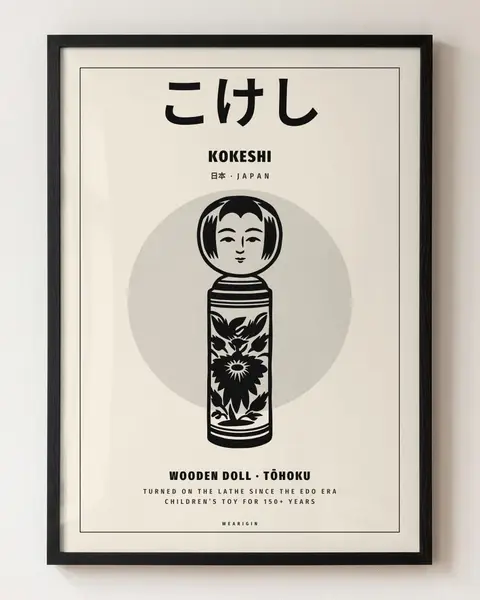
Kokeshi (wooden doll)
A doll without arms or legs, turned from leftover wood.
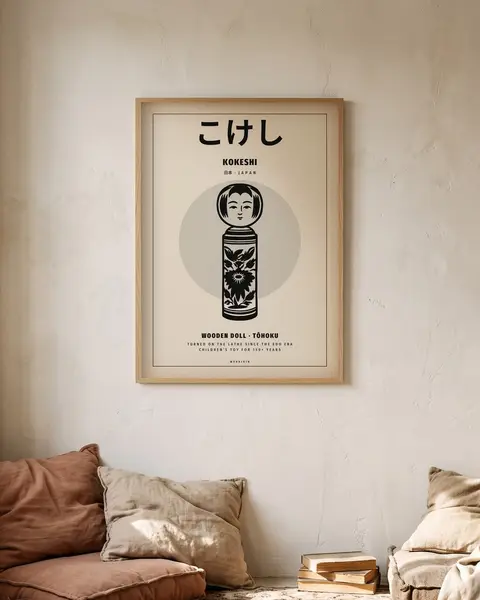
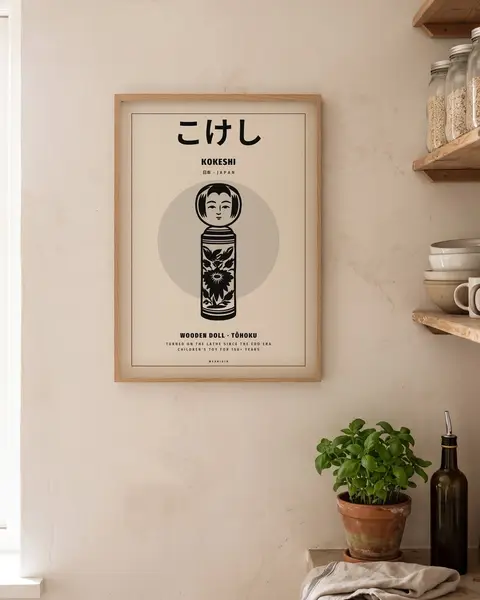
Colour: Black, light ground
€6.90
Digital file · instant download · no shipping
Download link valid for 30 days · up to 10 downloads · details
The download link is valid for 30 days from the date of provision and may be used a maximum of 10 times.
What you get
- · The chosen colour as 4 vector PDFs for standard frames: 50 × 70 cm (also 40 × 56, 30 × 42), ISO A (A4–A1), 3:4 (30 × 40, 45 × 60 cm, 18 × 24 in), 2:3 (20 × 30, 40 × 60, 60 × 90 cm, 24 × 36 in) — plus the same as JPG for copy shops and photo services (300 dpi up to A2 or 20 × 30 in; larger: use the PDF)
- · PDF: sharp at any size · JPG: 300 dpi at the stated size, plus a short printing guide
- · Files, not a printed poster, no frame
- · For private use, not for resale
Licence
With your purchase you acquire a non-exclusive, non-transferable licence for private use of the files. Permitted: printing for your own private use (also via a copy shop or photo service).
Prohibited: reselling or passing on the files, commercial use, making products for sale, using the files to train AI systems, or any public distribution of the files.
All copyright and other rights in the designs remain with the seller.
Where to print?
- · Copy shop near you: bring the PDF on a USB stick or send it by e-mail
- · Photo service in a drugstore or online: choose a poster size of the same shape (e.g. A3 or 30 × 40)
- · At home: up to A3 on a good printer
- · Tip: matte paper around 200 g/m² looks best
About the design
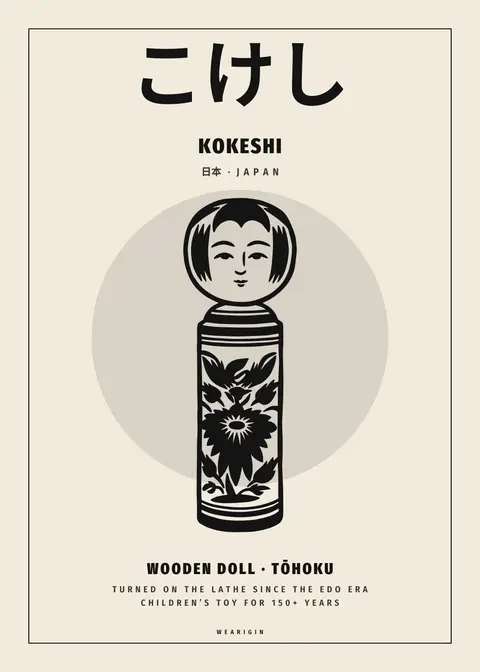
Kokeshi, こけし, are the wooden dolls of the Tōhoku region in northern Japan: a round head and a straight body turned on a lathe, no arms, no legs, a face of a few painted lines.
They were first made by kijishi, the lathe-working craftsmen of the hot-spring villages, near Tōgatta Onsen, and are said to date from the middle of the Edo period, when they were sold as toys to visitors of the springs; the tradition is more than 150 years old. The body carries floral or ring designs, mostly in red and black, under a coat of wax. The spelling of the name was agreed at the All-Japan Kokeshi Exhibition at Naruko Onsen in August 1939. Traditional kokeshi, dentō, are tied to particular places and springs and are classed in eleven types, of which Naruko is the most prominent; creative kokeshi, shingata, came after the Second World War with free shapes and colours. Since the 1950s makers sign their dolls on the base. Our drawing is a free interpretation, not a doll of one workshop. A round head with a fringe of hair and a small calm face sits on a slim body; rings mark the neck and the foot, and a large open flower with leaves fills the body. The name “kokeshi” and JAPAN stand beneath.
For a Japanese home abroad, for a child’s room, or for a wall that wants a quiet face.