46 characters · Digital poster
Japanese Hiragana
ひらがな
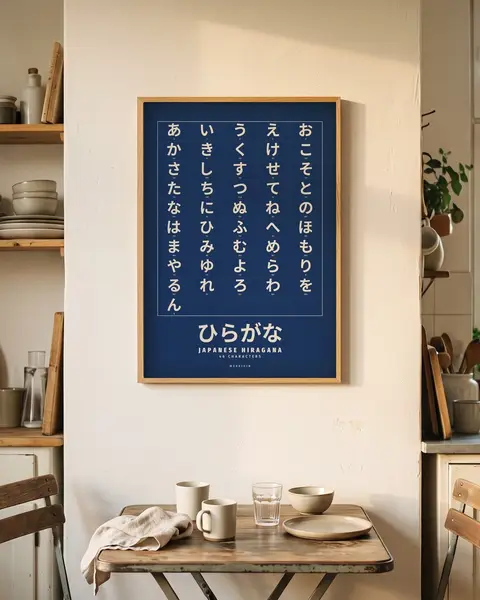
Colour: Night blue, dark ground
€6.90
Digital file · instant download · no shipping
Download link valid for 30 days · up to 10 downloads · details
The download link is valid for 30 days from the date of provision and may be used a maximum of 10 times.
What you get
- · The chosen colour as 4 vector PDFs for standard frames: 50 × 70 cm (also 40 × 56, 30 × 42), ISO A (A4–A1), 3:4 (30 × 40, 45 × 60 cm, 18 × 24 in), 2:3 (20 × 30, 40 × 60, 60 × 90 cm, 24 × 36 in) — plus the same as JPG for copy shops and photo services (300 dpi up to A2 or 20 × 30 in; larger: use the PDF)
- · PDF: sharp at any size · JPG: 300 dpi at the stated size, plus a short printing guide
- · Files, not a printed poster, no frame
- · For private use, not for resale
Licence
With your purchase you acquire a non-exclusive, non-transferable licence for private use of the files. Permitted: printing for your own private use (also via a copy shop or photo service).
Prohibited: reselling or passing on the files, commercial use, making products for sale, using the files to train AI systems, or any public distribution of the files.
All copyright and other rights in the designs remain with the seller.
Where to print?
- · Copy shop near you: bring the PDF on a USB stick or send it by e-mail
- · Photo service in a drugstore or online: choose a poster size of the same shape (e.g. A3 or 30 × 40)
- · At home: up to A3 on a good printer
- · Tip: matte paper around 200 g/m² looks best
About the poster
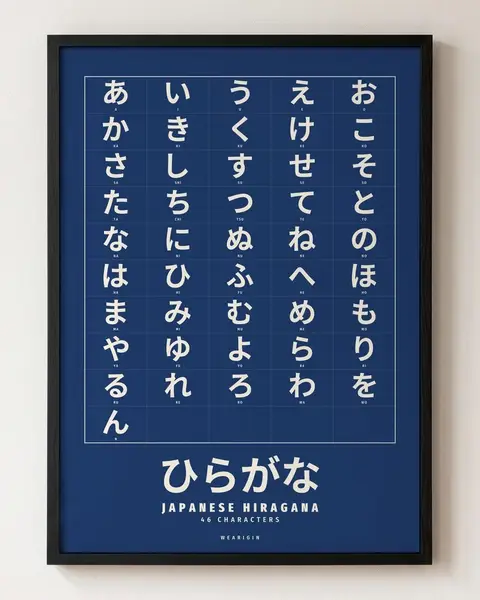
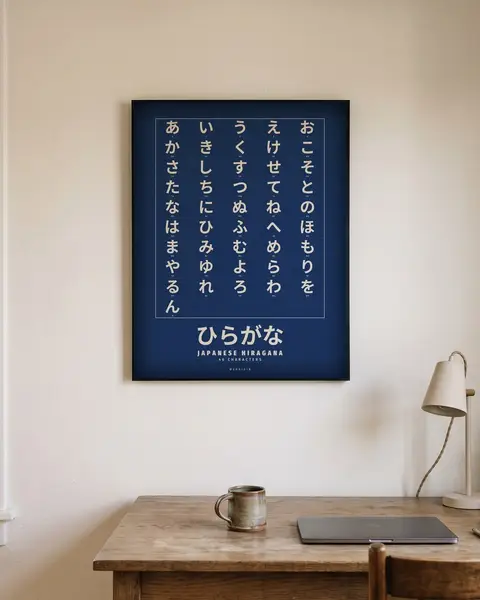
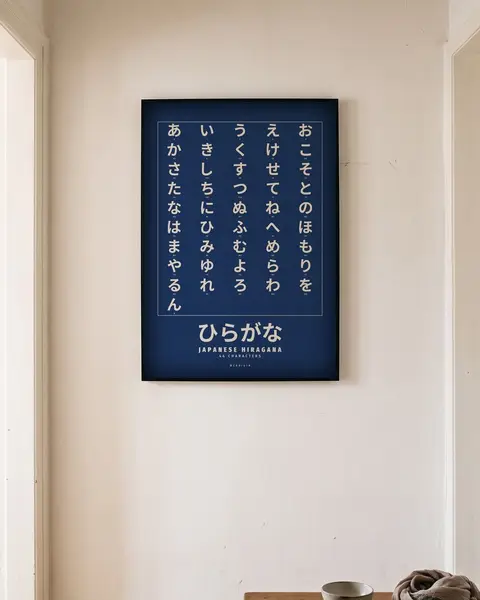
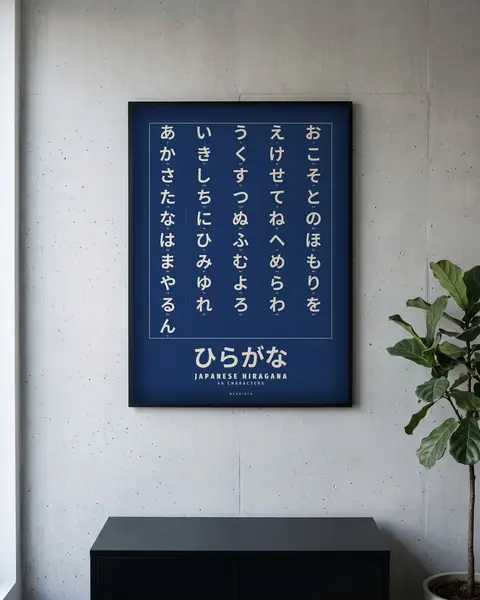
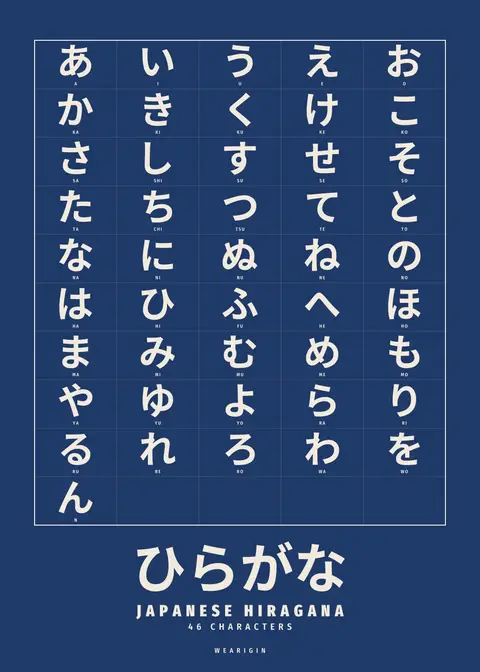
This Japanese hiragana poster shows the 46 characters of the syllabary in the gojūon order, the “fifty sounds” table, from a, i, u, e, o to wa, wo and n, each with its reading in Latin letters.
Hiragana is one of the three scripts of Japanese, beside the angular katakana and the Chinese characters, kanji. Each sign stands not for a letter but for a syllable, ka, ki, ku, ke, ko, and the table is built from five vowels and ten rows of consonants; three of the fifty cells, yi, ye and wu, have never been used, and a small mark, the dakuten, turns ka into ga and ha into ba. The signs grew out of cursive, simplified forms of kanji that had been borrowed for their sound alone, a practice that began in the 5th century. In the Heian court hiragana was called onnade, “women’s hand”, and the first great novels of Japan, among them The Tale of Genji, were written in it. A reform of 1900 fixed one sign for each syllable; the older variant forms are known as hentaigana. The iroha, a 10th-century poem that uses every sign exactly once, served for centuries as the alphabet song of Japan.
The poster sets the 46 signs in the gojūon grid, five to a row, with the word ひらがな in large characters beneath.
For children of Japanese families abroad, for anyone taking the first step into Japanese, or for a wall that wants the softest script in the world.
How to read the name: hiragana, «the plain kana», the smooth syllabary beside the angular katakana.