افغانستان · Afghanistan · Digital poster
Ghazni · Minaret
The minaret of Bahram Shah, a tower of brick ornament.
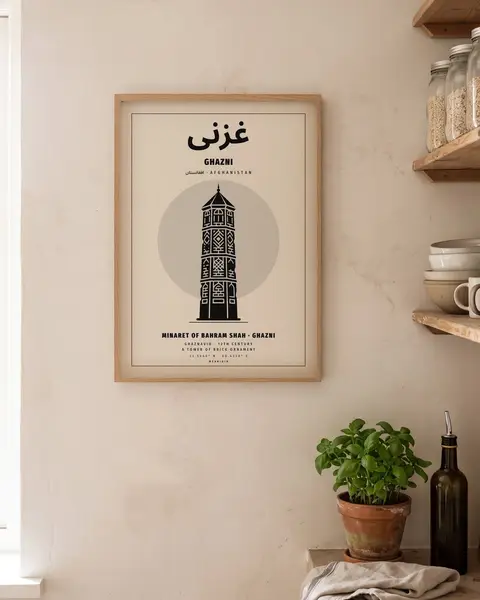
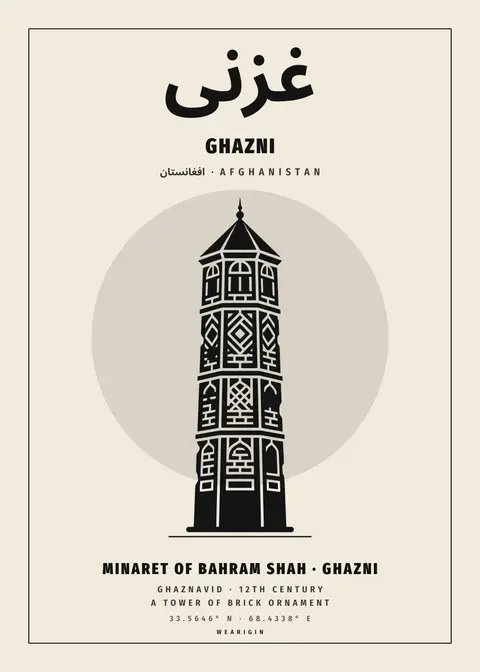
Colour: Black, light ground
€6.90
Digital file · instant download · no shipping
Download link valid for 30 days · up to 10 downloads · details
The download link is valid for 30 days from the date of provision and may be used a maximum of 10 times.
What you get
- · The chosen colour as 4 vector PDFs for standard frames: 50 × 70 cm (also 40 × 56, 30 × 42), ISO A (A4–A1), 3:4 (30 × 40, 45 × 60 cm, 18 × 24 in), 2:3 (20 × 30, 40 × 60, 60 × 90 cm, 24 × 36 in) — plus the same as JPG for copy shops and photo services (300 dpi up to A2 or 20 × 30 in; larger: use the PDF)
- · PDF: sharp at any size · JPG: 300 dpi at the stated size, plus a short printing guide
- · Files, not a printed poster, no frame
- · For private use, not for resale
Licence
With your purchase you acquire a non-exclusive, non-transferable licence for private use of the files. Permitted: printing for your own private use (also via a copy shop or photo service).
Prohibited: reselling or passing on the files, commercial use, making products for sale, using the files to train AI systems, or any public distribution of the files.
All copyright and other rights in the designs remain with the seller.
Where to print?
- · Copy shop near you: bring the PDF on a USB stick or send it by e-mail
- · Photo service in a drugstore or online: choose a poster size of the same shape (e.g. A3 or 30 × 40)
- · At home: up to A3 on a good printer
- · Tip: matte paper around 200 g/m² looks best
About the design
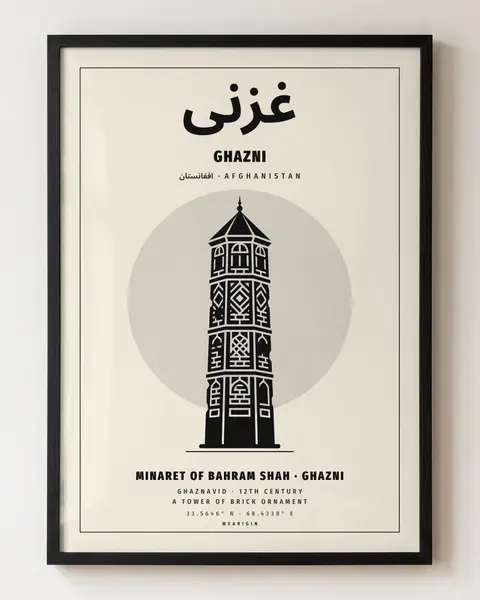
Ghazni, in central Afghanistan, was the capital of the Ghaznavid empire. On the plain north-east of the city stand two brick minarets, the last remains of that empire’s mosques. Our sheet shows the one built by Bahram Shah.
Sultan Mas’ud III (1099–1115) raised the first tower; his son Bahram Shah (1118–1157) the second, about 600 metres away. Both were built of fired brick in the mid-12th century and dressed in terracotta panels with geometric patterns and inscriptions in Kufic and Naskh script. They once rose over 44 metres; in 1902 an earthquake brought down the upper halves, and about 20 metres remain of each. The base of the older tower is an eight-pointed star. Sheet-metal roofs were added in the 1960s. The minarets are the only surviving parts of Bahram Shah’s mosque.
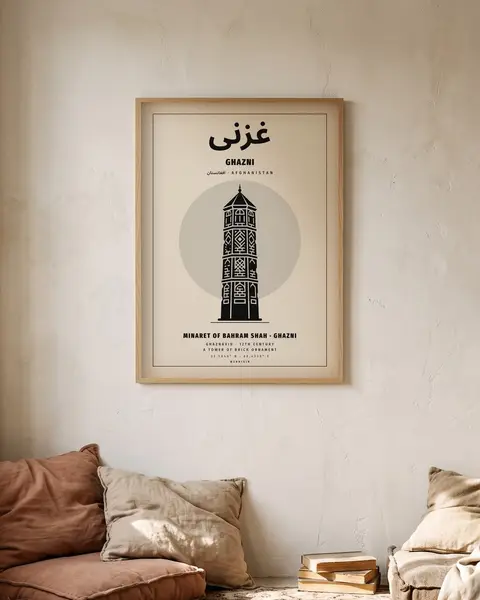
Our drawing is a free view of the tower, not a measured record. A tall shaft with a pointed roof is divided into bands of diamonds, small arches and brick lattice. Above it stands the city’s name in Persian script, غزنی, with the Latin form below; under the drawing the two fact lines and the coordinates.
For a family from Ghazni living abroad, for students of Islamic architecture, or for anyone who likes a tower built of pattern.