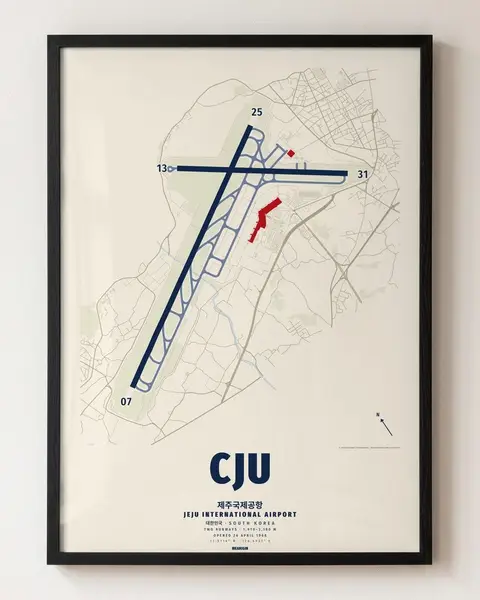
1 to 10 · Digital poster
Korean numbers
숫자
Colour: Black, dark ground
€6.90
Digital file · instant download · no shipping
Download link valid for 30 days · up to 10 downloads · details
The download link is valid for 30 days from the date of provision and may be used a maximum of 10 times.
What you get
- · The chosen colour as 4 vector PDFs for standard frames: 50 × 70 cm (also 40 × 56, 30 × 42), ISO A (A4–A1), 3:4 (30 × 40, 45 × 60 cm, 18 × 24 in), 2:3 (20 × 30, 40 × 60, 60 × 90 cm, 24 × 36 in) — plus the same as JPG for copy shops and photo services (300 dpi up to A2 or 20 × 30 in; larger: use the PDF)
- · PDF: sharp at any size · JPG: 300 dpi at the stated size, plus a short printing guide
- · Files, not a printed poster, no frame
- · For private use, not for resale
Licence
With your purchase you acquire a non-exclusive, non-transferable licence for private use of the files. Permitted: printing for your own private use (also via a copy shop or photo service).
Prohibited: reselling or passing on the files, commercial use, making products for sale, using the files to train AI systems, or any public distribution of the files.
All copyright and other rights in the designs remain with the seller.
Where to print?
- · Copy shop near you: bring the PDF on a USB stick or send it by e-mail
- · Photo service in a drugstore or online: choose a poster size of the same shape (e.g. A3 or 30 × 40)
- · At home: up to A3 on a good printer
- · Tip: matte paper around 200 g/m² looks best
About the poster
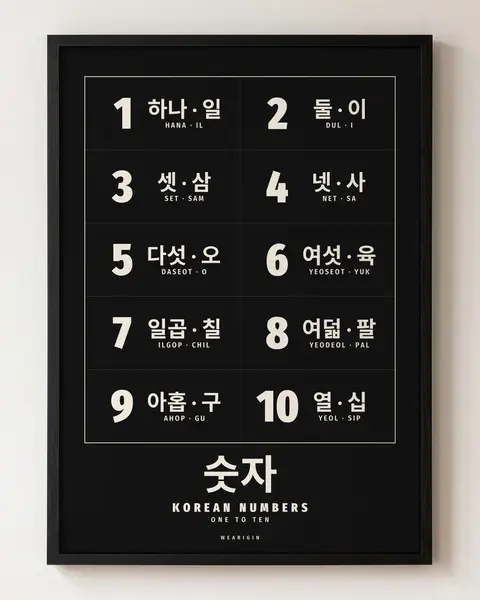
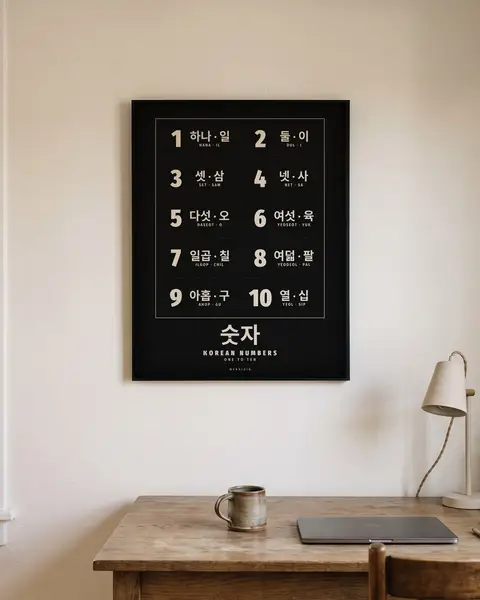
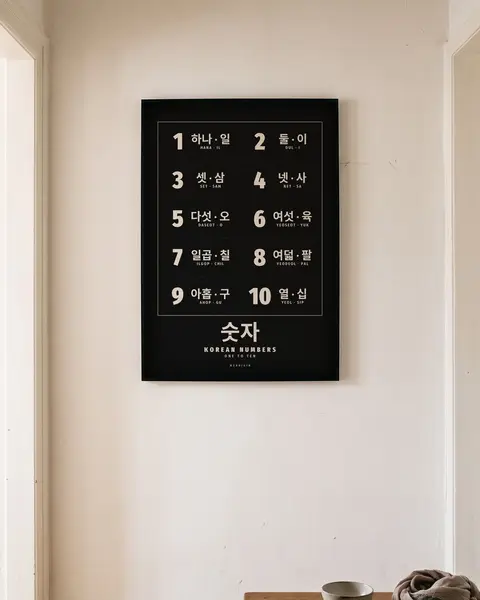
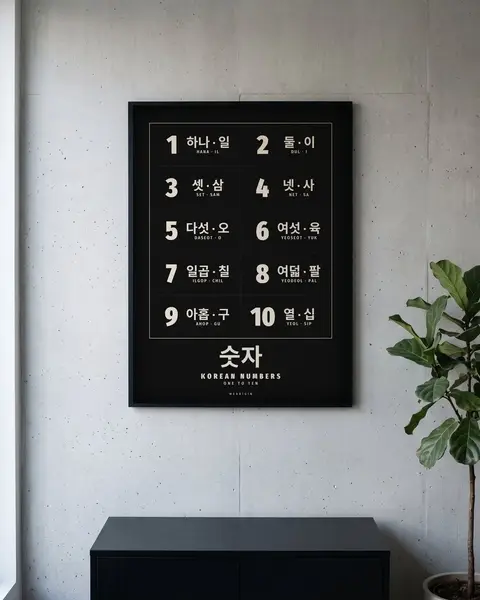
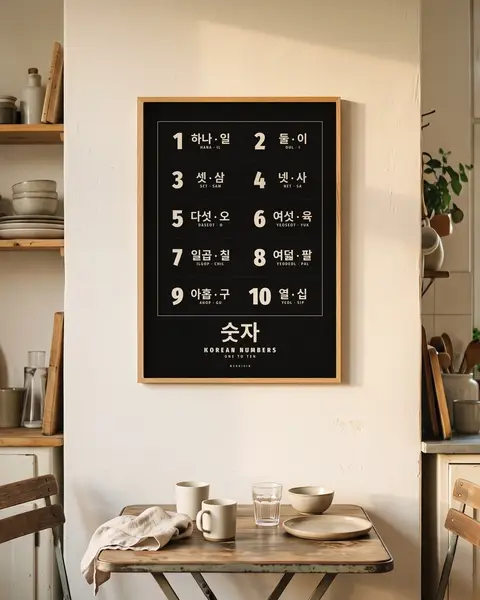
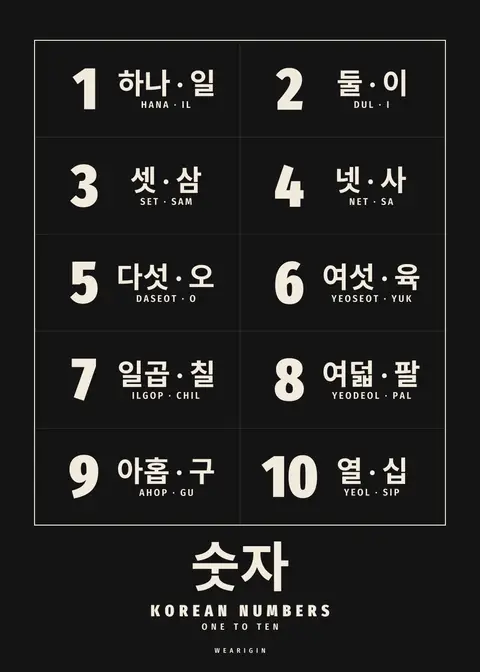
This poster shows the Korean numbers 1–10 in both of the language’s counting systems: the native Korean words and the Sino-Korean words, in Hangul and in Latin letters side by side.
Korean has two regularly used sets of numerals. The native set, hana, dul, set, net, daseot, yeoseot, ilgop, yeodeol, ahop, yeol, is used for counting things, people and hours and for giving one’s age, and it runs up to 99. The Sino-Korean set, il, i, sam, sa, o, yuk, chil, pal, gu, sip, came with the Chinese characters and is used for dates, money, minutes, addresses and telephone numbers, and for every number above 99. A Korean child learns both and knows without thinking which one a situation asks for: three apples take the native word, three o’clock the native word for the hour and the Sino-Korean word for the minutes. The words themselves are written in Hangul, the alphabet King Sejong promulgated in 1446, and the digits on the poster are the Western digits Korea uses in print.
Each cell carries the digit, the two Korean words separated by a dot, and both transliterations in small capitals.
For children of Korean families abroad, for learners who keep mixing up the two systems, or for a wall that counts twice.
How to read the name: sutja, «numbers».